
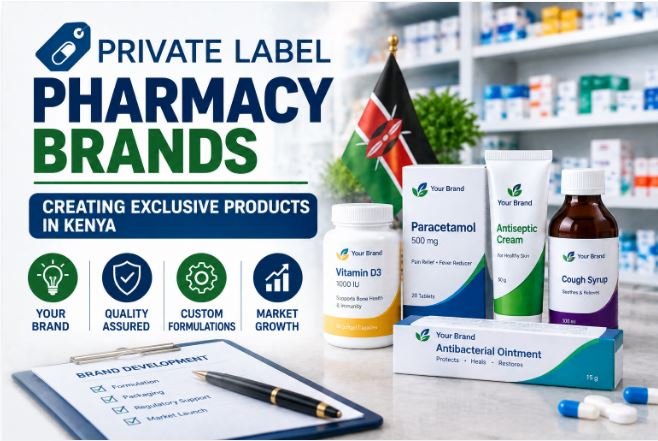
Private Label Pharmacy Brands: Creating Exclusive Products in Kenya
A pharmacy in Nairobi stocks branded medicines. Popular products. Good margins. But customers price comparing. Finding cheaper alternatives. Revenue pressure. Competitors everywhere. Selling same products. Price war ongoing. Differentiation absent. Margin pressure mounting. Owner frustrated. Business commoditized. Growth stalling.
Another pharmacy owner same city. Developing private label products. Creating own brand. Exclusive formulations. Building identity. Customers loyal. Premium positioning. Margin protection. Competitive advantage. Differentiation clear. Business thriving. Brand identity. Growth accelerating.
Same market. Different brand strategy. Different business outcome.
For Kenyan pharmacy owners, private label represents breakthrough opportunity. Brand loyalty builds. Customer retention increases. Margins improve. Yet many pharmacies avoiding private label. Complexity seeming daunting. Investment seeming risky. Regulatory seeming complex. Yet private label is achievable. Systems exist. Processes learnable. Brands can be built. Competitive advantage can be created. Business can differentiate.
Kenya’s Private Label Opportunity
Kenyan pharmacies face specific private label obstacles.
Regulatory uncertainty. Licensing requirements. Registration procedures. Quality standards. Regulatory pathway unclear. Compliance confusion. Process complexity. Guidance limited. Regulatory navigation difficulty.
Sourcing challenges. Finding manufacturers. Quality assurance. Batch consistency. Production reliability. Supply coordination. Manufacturing relationships. Partnership difficulty. Sourcing complexity.
Quality management. Testing requirements. Standard adherence. Consistency maintenance. Quality assurance. Product reliability. Batch variation. Quality control. Operational challenge.
Capital investment. Initial tooling. Equipment. Manufacturing setup. Minimum orders. Financial commitment. Investment size. Cost barrier. Financial pressure.
Branding complexity. Identity creation. Packaging design. Labeling requirements. Regulatory compliance. Brand development. Marketing support. Creative investment. Branding challenge.
Customer acceptance. Brand recognition. Trust building. Customer adoption. Market education. Awareness building. Acceptance challenge. Customer confidence. Market resistance.
Competitive response. Competitor reaction. Price pressure. Market pressure. Competitive intensity. Response management. Ongoing competition. Strategic pressure.
Kenya’s private label landscape offers significant opportunity.
Private Label Pharmacy Fundamentals
Understanding private label essentials.
Private label definition. Pharmacy-branded products. Exclusive formulations. Unique positioning. Customer loyalty. Brand differentiation. Market positioning. Competitive advantage. Business model. Strategic approach.
Private label benefits. Higher margins. Better profitability. Brand loyalty. Customer retention. Differentiation. Competitive advantage. Customer relationship. Revenue growth. Strategic value.
Private label scope. Basic medicines. Common treatments. Pain relievers. Antibiotics. Cough syrup. Vitamins. Categories wide. Product variety. Market breadth.
Customer motivation. Loyalty. Habit. Convenience. Quality perception. Brand trust. Repeat purchase. Customer behavior. Purchase driver.
Competitive positioning. Premium positioning. Value positioning. Discount positioning. Market niche. Brand identity. Competitive stance. Market strategy. Strategic choice.
Margin opportunity. Higher markups. Better profitability. Volume opportunity. Customer lifetime value. Revenue expansion. Financial advantage. Profitability improvement. Business driver.
Brand building. Identity creation. Trust development. Loyalty building. Market presence. Recognition. Customer relationship. Brand equity. Long-term value.
Understanding fundamentals enables private label success.
Building Private Label Strategy
Practical brand development.
Research market. Understanding customer needs. Identifying gaps. Noticing opportunities. Market analysis. Opportunity identification. Insight development. Strategic foundation.
Select products. Choosing focus category. High-demand products. Profitable products. Quality potential. Product selection. Strategic focus. Market fit.
Design brand. Creating brand identity. Logo design. Packaging design. Brand messaging. Visual identity. Brand creation. Market presentation.
Find manufacturer. Locating reliable partners. Evaluating quality. Comparing pricing. Negotiating terms. Partnership development. Manufacturing agreement. Production partnership.
Develop formulation. Creating unique formula. Competitive advantage. Patent protection. Distinctive feature. Differentiation. Product uniqueness. Market differentiation.
Ensure quality. Testing products. Verifying standards. Batch consistency. Quality assurance. Regulatory compliance. Safety assurance. Quality discipline. Credibility building.
Register with PPB. Completing registration. Meeting requirements. Regulatory compliance. Legal authorization. Official approval. Market authority. Regulatory compliance. Legal legitimacy.
Create packaging. Designing labels. Including required information. Regulatory compliance. Professional appearance. Brand presentation. Visual appeal. Customer perception.
Plan launch. Scheduling introduction. Marketing preparation. Staff training. Launch strategy. Market entry. Introduction planning. Timing coordination.
Promote brand. Building awareness. Customer education. Market communication. Brand visibility. Customer acquisition. Market presence. Growth strategy.
Strategic development ensures private label success.
Managing Private Label Operations
Operational private label management.
Quality control. Testing regularly. Monitoring standards. Batch verification. Consistency assurance. Quality maintenance. Ongoing discipline. Excellence assurance.
Inventory management. Stock planning. Volume forecasting. Storage management. Rotation discipline. Waste prevention. Inventory efficiency. Operational discipline.
Pricing strategy. Cost-plus calculation. Competitive positioning. Margin targets. Price communication. Pricing strategy. Revenue optimization. Financial planning.
Customer education. Explaining benefits. Building confidence. Addressing concerns. Quality reassurance. Trust building. Relationship building. Customer support.
Staff training. Teaching product knowledge. Building confidence. Recommendation capability. Sales training. Staff capability. Knowledge assurance. Team readiness.
Brand protection. Maintaining quality. Monitoring perception. Managing reputation. Brand defense. Relationship maintenance. Trust protection. Brand equity preservation.
Supplier relationship. Maintaining communication. Quality monitoring. Consistency verification. Partnership management. Communication discipline. Relationship maintenance. Partnership strength.
Operational discipline sustains private label success.
Common Private Label Mistakes
Organizations make predictable errors.
Skipping research. No market study. Unclear positioning. Wrong products. Product mismatch. Market failure. Strategic error. Planning absence.
Ignoring quality. Cutting corners. Poor manufacturing. Quality issues. Customer complaints. Brand damage. Reputation harm. Strategic error. Quality failure.
Weak branding. Unclear identity. Poor design. Confusing messaging. Brand confusion. Market invisibility. Branding failure. Communication failure.
No manufacturer relationship. Unreliable supplier. Quality inconsistency. Supply disruption. Business disruption. Partnership failure. Operational vulnerability. Relationship weakness.
Overpricing. Pricing too high. Customer resistance. Sales loss. Adoption failure. Market rejection. Pricing error.
Underpricing. Pricing too low. Margin destruction. Profitability loss. Financial pressure. Pricing error. Sustainability concern.
No promotion. Silent launch. Customer unaware. Awareness absent. Sales loss. Market invisibility. Communication failure.
No differentiation. Same products. No uniqueness. Competition unchanged. Advantage absent. Strategic failure. Differentiation absence.
Mistakes are preventable with planning.
Implementing Private Label
Systematic approach ensures success.
Start research. Understanding market. Identifying opportunities. Analyzing competition. Market study. Opportunity assessment. Strategic foundation.
Select category. Choosing focus. High-potential products. Profitable items. Market fit. Category selection. Strategic focus.
Design brand. Creating identity. Logo design. Brand message. Brand development. Visual identity. Market presentation.
Find partner. Locating manufacturer. Evaluating quality. Negotiating terms. Partnership development. Manufacturing relationship. Production partnership.
Develop formula. Creating distinctive product. Competitive advantage. Unique positioning. Product development. Differentiation. Market advantage.
Ensure compliance. Meeting regulations. Testing products. Registering with PPB. Legal compliance. Regulatory adherence. Market legitimacy.
Create packaging. Designing labels. Including requirements. Professional presentation. Brand presentation. Customer perception. Market readiness.
Prepare launch. Training staff. Preparing marketing. Creating strategy. Launch planning. Implementation preparation. Market entry readiness.
Monitor launch. Tracking sales. Measuring response. Gathering feedback. Performance assessment. Results evaluation. Learning source.
Optimize continuously. Refining based on feedback. Improving products. Enhancing marketing. Continuous improvement. Process evolution. Excellence building.
Systematic implementation ensures private label success.
Building Brand Loyalty
Creating customer commitment.
Consistent quality. Maintaining standards. Batch reliability. Performance consistency. Quality assurance. Customer confidence. Trust building. Relationship foundation.
Fair pricing. Setting reasonable prices. Value communication. Price fairness. Customer satisfaction. Loyalty building. Relationship strength. Customer commitment.
Responsive service. Addressing concerns. Solving problems. Customer support. Problem resolution. Relationship quality. Customer care. Loyalty reinforcement.
Community engagement. Supporting community. Building relationships. Social responsibility. Community connection. Goodwill building. Brand extension. Loyalty building.
Customer recognition. Appreciating loyalty. Offering rewards. Building connection. Recognition. Appreciation. Relationship. Loyalty reinforcement.
Continuous improvement. Improving products. Responding to feedback. Evolution. Customer-focused. Continuous refinement. Excellence pursuit. Loyalty building.
Brand loyalty, when built on quality and customer care, creates defensible competitive advantage.
The Supplier Relationship Angle
For Kenyan pharmacy owners developing private label brands, supplier relationships matter significantly.
Suppliers offering custom formulations enable unique products. Suppliers providing reliable manufacturing enable consistent quality. Suppliers supporting private label development enable brand success. Suppliers cooperating with pharmacy vision enable partnership success.
When Kenyan pharmacies are building private label brands, working with exporters who understand private label opportunity becomes valuable. Exporters offering custom formulations. Exporters providing quality manufacturing. Exporters supporting brand development. Resources highlighting reliable pharmaceutical exporters supporting Kenya private label pharmacy brands and creating exclusive products in Kenyan market can help identify suppliers positioned to support private label success.
Moving Forward
For Kenyan pharmacy owners:
Research market. Understanding customer needs. Identifying gaps. Analyzing competitors. Market study. Opportunity assessment.
Select products. Choosing focus. High-demand items. Profitable products. Product selection. Strategic focus.
Design brand. Creating identity. Logo. Messaging. Brand development. Visual identity.
Find manufacturer. Locating partners. Evaluating quality. Negotiating terms. Partnership development.
Develop formula. Creating unique product. Competitive advantage. Differentiation.
Ensure quality. Testing products. Meeting standards. Regulatory compliance. Quality assurance.
Create packaging. Designing labels. Professional presentation. Brand presentation.
Plan launch. Preparing strategy. Training staff. Launch planning.
Monitor results. Tracking sales. Measuring response. Gathering feedback.
Build loyalty. Maintaining quality. Responsive service. Customer appreciation.
Private label pharmacy brands, when developed with market insight, executed with quality discipline, and supported with customer care, create defensible competitive advantage and sustainable profitable growth in Kenya’s dynamic pharmacy market.
That’s how Kenyan pharmacies build lasting brands and thrive through differentiation.
