
National Mental Health Programme: Policy vs Implementation
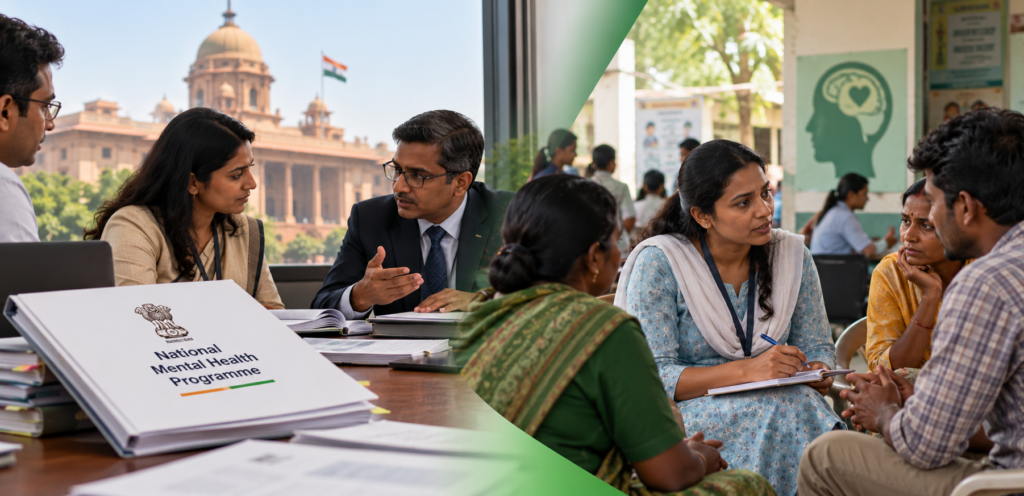
India’s approach to mental healthcare has evolved over several decades, with increasing recognition that mental health services need to be available beyond specialist hospitals and major urban centres. Policy frameworks can establish priorities, define approaches, and create systems for delivering care. However, the impact of any public health programme ultimately depends on what happens during implementation.
This distinction is particularly important when discussing the National Mental Health Programme. A national framework can provide direction for strengthening mental health services, but translating policy objectives into accessible services requires trained professionals, infrastructure, funding, coordination, awareness, and effective referral systems.
The difference between policy and implementation does not necessarily mean that a programme has failed. It highlights the practical challenge of converting broad public health objectives into services that people can actually access and use.
Why National Mental Health Policy Matters
Mental health needs to be addressed at a population level because individual clinical services alone cannot meet every community need.
A national framework can help establish priorities for mental health promotion, prevention, treatment, rehabilitation, and service delivery. It can also encourage governments and healthcare systems to treat mental health as part of public health rather than as an issue addressed only through specialised institutions.
Policy can therefore create the structure within which different levels of healthcare can contribute.
From Policy to Service Delivery
A policy document can state what a healthcare system intends to achieve. Implementation determines whether those objectives become practical services.
For example, improving access to mental healthcare may require trained professionals, functioning facilities, medicines where appropriate, referral pathways, community outreach, and systems for follow up.
If one part of the system is missing, access may still remain limited.
This is why implementation needs to be considered as a connected process rather than a single activity.
The Importance of District Level Services
District based mental health services are important because they can bring care closer to communities.
The District Mental Health Programme is an important part of translating broader public mental health priorities into services at the district level. District systems can support mental health care through local healthcare facilities, trained personnel, referral arrangements, awareness activities, and other appropriate services.
However, the availability and effectiveness of these services can vary according to local conditions.
This creates an important difference between having a programme framework and ensuring consistent implementation across different parts of the country.
Why Implementation Can Be Uneven
India has substantial differences between states, districts, urban centres, and rural communities. Healthcare infrastructure, workforce availability, population needs, geography, and local administrative capacity can all influence service delivery.
A policy may therefore be implemented differently in different locations.
One district may have relatively good access to trained professionals and referral services, while another may face significant workforce or infrastructure limitations.
Understanding these differences is essential when evaluating public mental health programmes. National progress should not automatically be assumed to mean that every community has equal access.
The Mental Health Workforce
One of the most important factors affecting implementation is the availability of appropriately trained professionals.
Mental healthcare can involve psychiatrists, psychologists, psychiatric nurses, social workers, counsellors, community health workers, and other professionals depending on the type of service.
A shortage or uneven distribution of trained professionals can limit the capacity of local services.
Strengthening the workforce therefore requires more than recruiting professionals. Systems also need training, supervision, retention, appropriate working conditions, and opportunities for professional development.
Integrating Mental Health With Primary Care
People do not always approach specialist mental health services first. They may visit primary healthcare facilities because of sleep difficulties, fatigue, physical symptoms, stress, or other concerns.
Integrating mental health into primary healthcare can create opportunities for earlier identification and appropriate referral.
Healthcare workers need sufficient knowledge and clear referral pathways to support this approach effectively.
Integration also requires coordination. Simply adding mental health responsibilities to already overloaded healthcare workers may not produce sustainable results without adequate training and resources.
Mental Health Awareness and Help Seeking
Even when services exist, people may not use them.
Stigma, lack of awareness, concerns about confidentiality, financial barriers, family attitudes, and uncertainty about where to seek help can influence whether someone accesses care.
Public mental health policy therefore needs to consider awareness alongside service availability.
Community education can help people understand that mental health concerns are health issues and that appropriate support is available. However, awareness campaigns are most useful when people can access meaningful services after deciding to seek help.
The Role of Referral Systems
Mental healthcare often requires different levels of intervention. A person may begin by speaking with a primary healthcare worker and later require specialist assessment or another form of support.
Clear referral systems help connect these levels.
Without reliable referral pathways, people may experience delays, repeated assessments, fragmented care, or uncertainty about where to go next.
Effective implementation therefore requires coordination between primary care, district services, specialist facilities, community resources, and other relevant systems.
Access Is More Than Physical Distance
Bringing a mental health service closer to a community can reduce geographical barriers, but accessibility has several dimensions.
People also need to know that the service exists, understand how to reach it, be able to afford associated costs, feel comfortable using it, and receive care in a way that respects their needs.
Language, cultural expectations, disability, transportation, privacy, and availability of appointments can also affect access.
A service may technically exist while remaining difficult for certain groups to use.
Continuity of Care
Receiving an initial consultation is only one part of mental healthcare.
People may require follow up appointments, medication management, psychological interventions, rehabilitation, social support, or other forms of continuing care depending on their circumstances.
If services are available only intermittently, people may struggle to maintain treatment.
Implementation should therefore consider continuity rather than measuring success only through the number of people who have accessed a service at least once.
The Importance of Rehabilitation
Mental health policy is not limited to diagnosis and treatment.
For some people, rehabilitation and social support are important parts of recovery and long term functioning. These services can help individuals participate in family life, education, employment, and community activities according to their circumstances.
A comprehensive public mental health system therefore needs to consider recovery and participation alongside clinical care.
Technology as a Supporting Tool
Digital technology can potentially support public mental healthcare by improving communication, information access, remote consultations, professional coordination, and training.
However, technology cannot remove all barriers.
Digital access varies across communities, and some forms of mental healthcare require face to face assessment or intervention. Technology should therefore be considered a supporting component rather than a complete replacement for physical services.
Measuring Implementation
Evaluating a public mental health programme requires more than confirming that activities have taken place.
Useful measures may include service availability, workforce capacity, utilisation, referral completion, continuity of care, geographical reach, training coverage, and patient experience.
Qualitative information can also help explain why a service is being used or underused.
Good measurement allows policymakers and healthcare administrators to identify implementation gaps and determine where additional resources or changes may be required.
Policy Success and Ground Reality
A programme can be successful at one level while still facing challenges at another.
A national policy may establish an important framework. States may develop implementation mechanisms. Districts may establish services. Yet an individual seeking care may still face a long waiting period or difficulty finding an appropriate professional.
These different levels need to be examined together.
The experience of the person seeking care provides an important test of whether policy objectives are translating into meaningful access.
Funding and Resource Allocation
Implementation requires resources.
Mental health services need funding for professionals, facilities, medicines where appropriate, training, technology, awareness activities, data systems, and ongoing administration.
Resource allocation also needs to consider differences between communities. Areas with greater shortages or larger access barriers may require additional attention.
Without adequate and sustained resources, even well designed programmes can struggle to maintain consistent services.
Coordination Across Levels of Government
Public mental health delivery involves multiple administrative and healthcare structures.
National policy can provide direction, while state and district systems have important roles in implementation.
Coordination between these levels is therefore essential. Communication gaps, unclear responsibilities, or fragmented planning can make implementation more difficult.
Strong coordination can help align national priorities with local needs.
Listening to Communities
Policy decisions can be strengthened when they incorporate information from the people who use or provide services.
Healthcare workers can identify operational barriers. Families can describe difficulties with accessing care. People with lived experience can provide insight into how services are perceived and where systems create unnecessary obstacles.
Community feedback should therefore complement administrative data when programmes are evaluated.
What Better Implementation Can Look Like
Strengthening implementation does not necessarily require creating entirely new systems. In many cases, improvements may involve strengthening existing structures.
This can include improving workforce availability, ensuring reliable referral pathways, strengthening primary healthcare integration, increasing awareness, improving data collection, supporting continuity of care, and addressing local access barriers.
The priorities will vary between locations.
The important principle is that implementation should respond to evidence rather than relying on assumptions about what communities need.
Bridging the Policy and Practice Gap
The National Mental Health Programme provides an important policy foundation for strengthening public mental healthcare, but policy alone cannot determine what people experience when they seek support.
The District Mental Health Programme helps translate broader objectives into local services, making district level capacity an important part of implementation.
The gap between policy and practice should therefore be viewed as an area for continuous improvement. Better workforce planning, stronger referral systems, reliable funding, community participation, appropriate technology, and meaningful measurement can all contribute to more effective delivery.
A strong public mental health system is ultimately measured not only by the policies it creates but by whether people can access appropriate care when they need it. Closing that gap requires sustained attention to both national priorities and local realities.
