
Integrating WooCommerce, Magento or Shopify Orders With a Delivery Dispatch Platform
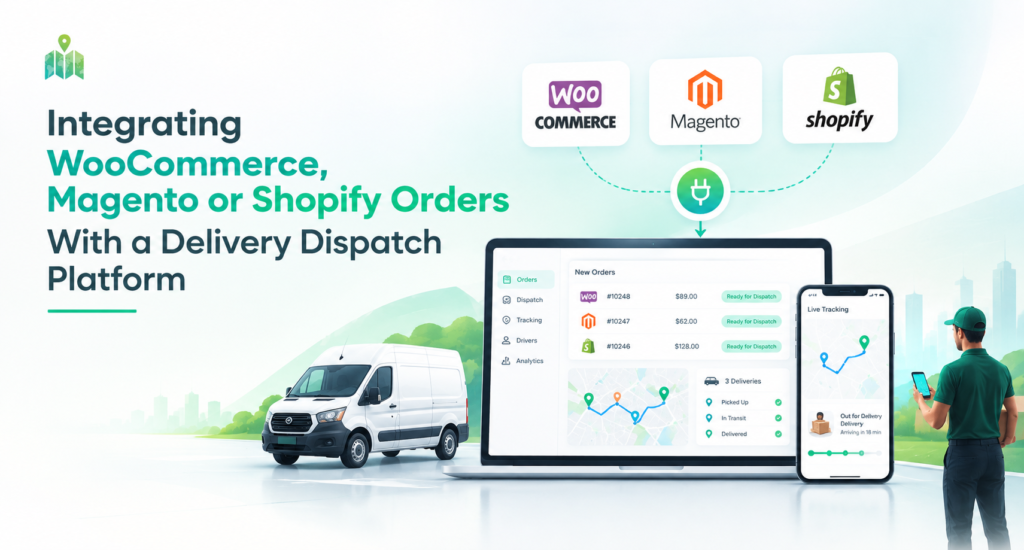
Integrating WooCommerce, Magento or Shopify Orders With a Delivery Dispatch Platform
E-commerce businesses grow rapidly as more people order goods online. Such companies strive to improve customer satisfaction by fulfilling orders swiftly and reliably. It does not matter if the business uses WooCommerce, Magento, or Shopify: an increasing number of transactions requires more efficient ways of processing the deliveries.
Connecting an e-commerce platform with a delivery dispatch tool helps business owners reduce order processing time, save on delivery costs, and build a positive customer experience.
Why Businesses Need to Integrate E-commerce Platforms with Delivery Dispatch Software
An e-commerce business does not end with a purchase. As soon as a customer places an order on a website, someone has to prepare it, assign a courier, plan the delivery route, and inform the buyer about the changes in the shipment status.
These activities become error-prone and time-consuming if the business has to rely on spreadsheets, emails, phone numbers, and paper documents. Furthermore, dispatch managers can miss orders or provide inaccurate information to couriers.
Using an e-commerce platform with a delivery dispatch integration streamlines operations and reduces mistakes.
Connecting the software tools allows the business to shift some responsibilities from the dispatch managers to automated processes.
For example, a company can save on time and effort by ensuring that the delivery platform only receives orders that the business has confirmed as valid. The integration removes the need to copy essential information from one system to another.
As a result, fewer resources are spent on routine tasks, and the dispatch managers can concentrate on improving the delivery process.
Integrating WooCommerce With a Delivery Dispatch Platform
WooCommerce is a flexible shopping platform that accommodates the needs of small and large businesses. Connecting it with the delivery dispatch software is advantageous because the former contains vital customer and order information.
Depending on the type of integration, the dispatch managers can view the details of an order, including the shipping address and phone number, items, and specific instructions.
In some cases, orders can appear in the delivery management software as soon as they arrive in the e-commerce platform. This way, WooCommerce dispatch software integration eliminates the need to wait for the order confirmation.
A local food store, for instance, can integrate its online platform with a delivery tracking application to reduce the time spent on printing and organizing delivery notes. Furthermore, businesses should define which order statuses apply to their delivery process.
In certain cases, delivery managers might need to update the state of an order in their software if the application does not support it. For example, orders in WooCommerce can change from “Processing” to “Shipped” and “Delivered,” which is possible to sync with the delivery tracking application.
Connecting Magento Orders With Delivery Dispatch Software
Adobe Commerce (formerly known as Magento) is suitable for organizations that sell high-value products, have a complex catalog of goods, and have numerous transactions.
The delivery integration for Magento becomes more sophisticated as businesses seek to optimize their logistics operations. For example, companies fulfill orders from multiple warehouses, distribute goods using various carriers, and operate in many regions.
A business can use a delivery tracking platform to consolidate the eligible orders and assign them to drivers depending on the route. The dispatch software helps manage bulk orders and drivers by prioritizing deliveries and utilizing the available resources efficiently.
An electronics business with multiple warehouses can integrate its Magento system with a delivery tracking application to sort the orders by location and assign them to local couriers. It is essential to define how the delivery management software interacts with other programs in case of order cancellations and returns.
During the testing phase, companies should ensure that their application does not create duplicates in the delivery tracking program when the customer updates the address or cancels the order.
Integrating Shopify With a Delivery Tracking Application
A business can launch an online store within days with Shopify. However, as it accumulates more orders, the company has to find a more efficient way of processing them.
A delivery tracking application can integrate with Shopify to retrieve and update the order information. Depending on the selected solution, courier management, driver assignment, and automatic order status updates can take place in real-time.
In addition, a delivery tracking application can help customers follow the progress of their orders. In some cases, the app allows courier tracking, arrival notifications, and order history. For example, a clothing company can synchronize its Shopify account with a delivery tracking tool to view all the customer orders in one place.
This way, the managers do not have to spend much time searching through numerous documents and emails.
Instead, they can create delivery routes, assign couriers, update order statuses, and send the necessary information to customers.
Before selecting the delivery tracking application, organizations should ensure that their Shopify plan, delivery method, and other tools are compatible with it. A company should examine specific requirements, such as shipping preferences, applications used, and tracking options.
Overall Benefits of E-commerce and Dispatch Software Integration
An e-commerce company can benefit from integrating its system with the delivery dispatch platform in several ways.
First, the order synchronization becomes automatic, reducing the risk of human errors and ensuring that all the information is up-to-date.
Second, dispatch managers can assign multiple orders to drivers based on their location, route, and other criteria if the application allows it.
At the same time, the application can optimize the delivery routes to reduce the distance and time spent on the road. As a result, transportation expenses are minimized, and the drivers can complete more deliveries per day.
A delivery tracking application serves as a communication bridge between the company and the customers.
It allows the former to update the status of an order and send notifications to the buyers, minimizing the number of incoming inquiries. Couriers can also update the order status as long as they deliver the products, so the buyers are aware of any changes.
In addition, the delivery tracking app can assist the business in managing the orders and drivers. For example, the organization can monitor the upcoming deliveries and detect potential issues during the transportation process.
All this leads to increased customer satisfaction as the company fulfills the orders in a timely manner, informs the customers about the delivery details, and reduces the overall delivery costs.
Best Practices for Integration of E-commerce Platforms and Delivery Dispatch Software
A company should assess its needs before integrating its e-commerce system with a delivery tracking tool.
For example, organizations must identify which order status changes prompt the delivery tracking application to update the information.
In addition, the managers should develop a series of actions for different reasons for order cancellation or delivery failure, updating statuses, and assigning drivers.
Before launching the integrated system, it is critical to ensure that all the customers’ addresses and phone numbers are correct.
An organization should also invest in security measures to protect the data and only share the necessary information with the delivery tracking application.
Finally, a business should test the integration to detect and resolve issues. It is necessary to update the status of sample orders and drivers and adjust the settings. After the launch, the companies should monitor problems with synchronization and find ways to resolve them.
To conclude, connecting WooCommerce, Magento, or Shopify with a delivery tracking tool is essential for an e-commerce business that seeks to improve its operations.
With the help of an application, organizations can automate and optimize the delivery process, reducing the risks of mistakes in the documentation and communication breakdown between the company and the customers.
Selecting the appropriate delivery management software and delivery tracking application is of utmost importance for an organization considering the scale of its operations, the number of orders, and the locations of its customers.
Ultimately, the ability to integrate a delivery platform with an e-commerce website can help a business provide better customer service and increase its competitiveness.
