
Extreme Outreach & Elevation: The Engineering Guide to Telescopic Boom Lifts
Introduction: Heavy High-Reach Infrastructure Operations
In modern civil engineering, high-rise commercial construction, stadium structural assembly, and shipyard maintenance, accessing elevated target zones across wide ground setbacks presents a significant engineering challenge. When job sites feature unexcavated foundation perimeters, soft shoulders, or deep utility trenches, aerial platforms cannot be positioned directly adjacent to the structure.
Deploying a heavy-duty telescopic boom lift provides the direct diagonal extension and extreme vertical reach required to execute high-altitude installations safely. Frequently referred to as “straight-stick” booms, these hydraulic extendable platforms offer superior structural rigidity, high basket payload capacities, and rapid elevation speeds.
Whether installing heavy glass curtain wall panels, erecting structural steel trusses, or applying protective coatings to industrial storage tanks, selecting the correct straight-stick platform architecture directly influences site safety, schedule execution, and operational productivity.
Technical Engineering Features of Telescopic Platforms
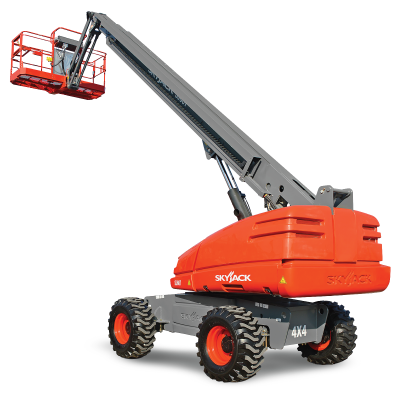
Telescopic booms are engineered specifically for long-range diagonal extension. Unlike jointed articulating booms that feature multiple folding arm sections, telescopic platforms extend linearly via internal hydraulic cylinders and heavy-duty extension chains inside nested boom sections.
Key Structural Features:
High Horizontal Outreach: Telescopic booms deliver the maximum horizontal outreach of any aerial work platform category, allowing technicians to work across ground setbacks exceeding 20 meters.
Active Oscillating Axles & 4WD: Heavy-duty rough-terrain drivetrains feature active oscillating axles and four-wheel drive (4WD), maintaining traction and chassis leveling across uneven, unpaved construction soil.
Proportional Hydraulic Controls: Multi-function proportional joysticks allow operators to elevate, extend, and rotate the turntable simultaneously with millimeter-level precision.
Dual-Capacity Envelope Tracking: Modern units utilize automated load-sensing systems that continuously adjust the working envelope based on basket weight, permitting higher payloads (e.g., up to 450 kg) at restricted outreach angles.
Global Manufacturer Architectures
Selecting the ideal high-reach machinery involves evaluating leading global manufacturers whose platform geometries match specific project demands.
| Manufacturer / Model Family | Primary Engineering Focus | Typical Site Application |
| Genie Telescopic Series | High basket payload capacity & fast telescoping speed | High-rise glass curtain wall installation & cladding |
| JLG Telescopic Series | Advanced load-sensing electronics & wide reach envelope | Structural steel erection & civil infrastructure |
| JCB Telescopic Series | Heavy-duty chassis design & rugged powertrain traction | Industrial plant construction & agricultural builds |
Deploying a premium genie telescopic boom lift provides site teams with smooth telescoping action and high basket capacities ideal for heavy material handling at height. Similarly, sourcing a jlg telescopic boom lift offers intuitive control interfaces and advanced envelope control systems that prevent operators from exceeding safe stability limits. For heavy civil engineering environments, a jcb telescopic boom lift delivers rugged chassis endurance across demanding terrain.
Procurement & Fleet Logistics: Telescopic Boom Lift Rental
For contractors managing fixed-phase construction schedules, securing a telescopic boom lift rental contract offers clear operational and financial advantages over direct machinery purchase:
Capital Expenditure Optimization: Renting high-reach equipment eliminates large upfront capital outlays, preserving working capital for raw materials and site labor.
Dynamic Fleet Scaling: Contractors can deploy 20-meter straight booms during early construction phases and swap to 40-meter or 50-meter units as building height increases.
Maintenance Overhead Elimination: Rental providers handle routine hydraulic fluid checks, engine overhauls, filter replacements, and emergency field repairs.
Third-Party Compliance Assurance: Professional rental depots deliver machinery complete with valid Third-Party Inspection (TPI) safety documentation, passing main contractor audits instantly.
Site Safety Protocols & Hazard Mitigation
Operating straight-stick telescopic booms at extreme elevations requires strict adherence to safety mandates:
Ground Load Capacity Audits: Because telescopic booms concentrate high operating loads on individual tires during extended outreach, ground bearing capacity must be verified prior to elevation.
Fall Restraint Systems: Operators working inside telescopic baskets must wear a full-body harness attached securely via a short restraint lanyard to designated basket anchor points.
Wind Speed Monitoring: Straight boom stability is sensitive to elevated wind gusts. Operations must cease when wind speeds exceed manufacturer thresholds (typically 12.5 m/s).
Overhead Clearance Checks: Maintain strict clearance buffers around energized high-voltage electrical lines and overhead crane runways.
Conclusion
Telescopic boom platforms represent the ultimate solution for extreme outreach and elevation across modern construction and civil engineering builds. Matching brand specifications to site geometry and securing equipment through certified rental partners ensures that high-altitude operations remain safe, compliant, and highly productive.

