
Commercial Embroidery Equipment for Garment Manufacturers
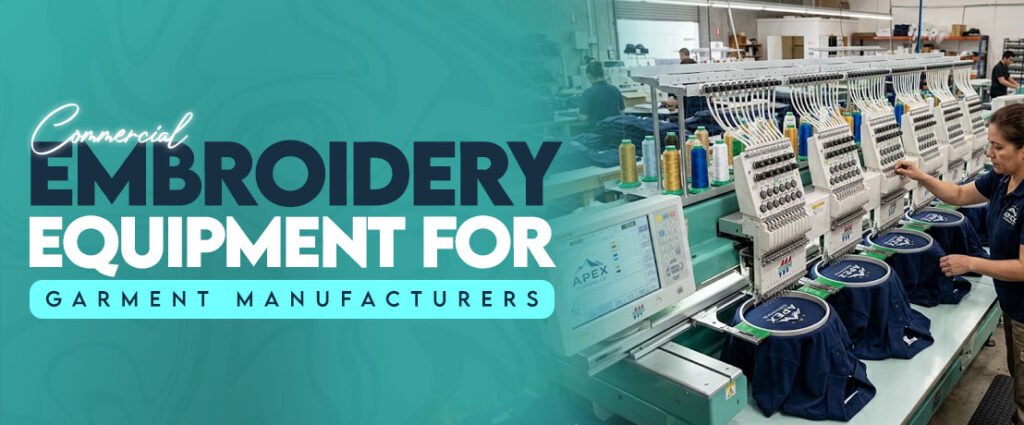
When a garment factory adds embroidery, the machine is only one piece of the puzzle. I have seen a setup look impressive on paper but struggle once different fabrics, hoop sizes, thread changes, and daily order volumes enter the picture. A commercial embroidery machine needs to match the garments, order pattern, and available workspace, while a custom embroidery digitizing service can help keep design preparation practical when the factory does not need a full-time digitizer.
For garment manufacturers, the better question is not simply, “Which machine is the fastest?” It is, “Which equipment can handle our actual garments every day without creating unnecessary work?” That means looking at heads, needles, frames, embroidery fields, file compatibility, maintenance, operator skills, and after-sales support before making a purchase.
What Equipment Do Garment Manufacturers Actually Need for Commercial Embroidery?
A manufacturing unit usually needs a combination of embroidery equipment and supporting tools. The exact setup depends on whether the factory decorates fabric panels before sewing, adds logos to finished garments, or handles both.
A factory making uniforms may need tubular frames for finished shirts and jackets. A factory producing large batches of embroidered panels may get more value from flat-type equipment designed for fabric pieces before sewing. Tajima, for example, lists its multi-head flat machines specifically for factories working on fabrics and parts before sewing, while its cylinder-type machines target finished products such as sports uniforms and hats.
Core Equipment vs Supporting Equipment
The core setup normally includes:
- Multi-head embroidery equipment
- Tubular and flat frames
- Cap frames when hats are part of the product line
- Embroidery software or access to digitizing services
- Hooping tables
- Backing and stabilizers
- Embroidery thread
- Bobbins and needles
- Thread storage
- Cutting and trimming tools
- Inspection and finishing space
- Computers and file-storage equipment
The supporting equipment may look less important at first, but it directly affects how smoothly the embroidery department works.
Quick Checklist for Manufacturing Units
Before ordering equipment, check these points:
- What garments will receive embroidery?
- Will designs go on finished garments or fabric panels?
- How many pieces need the same design?
- What is the average stitch count?
- What hoop sizes do the designs require?
- Do you need cap embroidery?
- How many thread colors appear in common designs?
- What file formats does your software accept?
- How much floor space can the factory dedicate to embroidery?
- Who will maintain and operate the machines?
This checklist can prevent an expensive mismatch later.
Types of Commercial Embroidery Machines for Garment Manufacturing
Manufacturers have several machine configurations to consider. The right choice depends heavily on the type and quantity of garments moving through the factory.
Multi-Head Embroidery Machines (2, 4, 6, 12, 20+ Heads)
Multi-head equipment is useful when the factory regularly decorates multiple identical garments. Each head works from the same design, so matching pieces can be embroidered together.
Current Tajima models show how wide the range can be. Its TMAR-KC cylinder machines come in 2, 4, 6, and 8 head configurations, while the TMAR-VC is a 12-head model. Its flat-type TMCR-VF line includes configurations reaching 20 and 30 heads.
That doesn’t mean a 20-head machine makes sense for every factory.
If your factory receives small batches with many different designs, a smaller setup may be easier to manage. If you repeatedly handle hundreds or thousands of garments with the same logo, more heads can make much better use of the available capacity.
Tubular and Flatbed Machines for Different Garment Types
Tubular machines work well with finished garments because the garment can sit around the machine arm. This setup helps with areas such as:
- Shirt fronts
- Sleeves
- Pockets
- Sports uniforms
- Hats
- Bags
Flat type machines suit fabric panels and pieces that the factory embroiders before garment assembly. Tajima describes its TMCP-VF and TMCR-VF flat models for large-lot apparel work on fabrics and parts before sewing.
Automatic and Industrial Machines vs Standard Commercial Models
A factory should look beyond the word “industrial.” Check the actual specifications and intended use.
Important differences can include:
- Number of heads
- Needle count
- Embroidery field
- Frame selection
- Maximum speed
- Automatic trimming
- Thread management
- Sensor systems
- Control interface
- Service access
For example, Tajima’s TMEZ-KC multi-head cylinder series supports 2, 4, 6, or 8 heads, 9/12/15 needles, and a listed maximum speed of 1100 rpm. The manufacturer also notes that actual embroidery speed vary with the garment, design, machine model, and operating conditions.
Which Machine Type Suits T-Shirts, Caps, Jackets and Uniforms?
- T-shirts: tubular frames are practical for finished shirts.
- Caps: choose a system with suitable cap frames and stable cap fixation.
- Jackets: check the arm and frame design because thicker garments need enough clearance.
- Uniforms: tubular multi-head equipment works well for repeated logos and names.
- Fabric panels: flat machines can suit embroidery before garment assembly.
The garment should drive the equipment decision, not the other way around.
Key Features to Check Before Buying a Commercial Embroidery Machine
Speed (SPM), Needle Count and Stitch Quality
Speed matters, but the highest number on a specification sheet does not automatically mean the fastest finished order.
A dense logo may require a lower operating speed than a simple lettering design. Fabric type, stitch direction, thread, backing, and design quality all affect the actual time.
Needle count also matters. More needles mean fewer manual thread changes when a design uses many colors. Current Tajima commercial models range from 6 to 15 needles on several multi-head lines, while some single-head systems go higher.
In practical work, I pay close attention to how a machine handles the actual design rather than focusing only on maximum speed.
Hoop Sizes, Embroidery Area and Cap Frame Compatibility
Check the largest designs your factory handles before choosing frames.
A machine may have a large maximum embroidery field, but that does not mean every frame supports the same area. Tajima notes that the actual stitchable area can vary depending on the frame, presser foot, and operating conditions.
Look for:
- Standard shirt hoops
- Large hoops
- Pocket hoops
- Sleeve options
- Cap frames
- Border frames
- Tubular frames
This becomes especially important when one factory serves several garment categories.
Thread Trimming, Color Changing and Auto-Sensors
Automatic features can reduce operator work and improve consistency.
Useful features include:
- Automatic thread trimming
- Automatic color changes
- Thread-break detection
- Needle-position controls
- Fabric sensors
- Thread management systems
- Automatic stop functions
Some newer Tajima systems use Intelligent Thread Management and a Digitally Controlled Presser foot to adjust thread supply and presser foot pressure based on stitch and fabric conditions.
These features matter most when the factory runs many hours each day.
Software Compatibility and File Formats (DST, PES, EXP)
Embroidery machines do not work directly from ordinary artwork such as JPG or PNG in the same way a computer does.
The artwork first needs embroidery digitizing, where the image becomes stitch instructions.
Common embroidery formats include:
- DST
- PES
- EXP
- JEF
- Other manufacturer-specific formats
Always check the exact format required by the machine and controller before sending files to the operator.
A clean file also matters. A technically compatible DST file can still stitch poorly if the digitizer used excessive density, weak underlay, poor stitch direction, or unsuitable compensation.
How to Choose the Right Machine for Your Output Volume?
Capacity planning starts with your actual orders.
Small Batch, Mid-Size and High-Volume Manufacturing Needs
A simple way to divide the workload is:
Small batch
- Fewer repeated garments
- Many different designs
- Shorter order quantities
- Greater need for flexibility
Mid-size volume
- Regular uniform or apparel orders
- Repeated logos
- Several designs each week
- Better use of multiple heads
High volume
- Large quantities of matching garments
- Stable customer orders
- Repeated designs
- Strong need for synchronized heads
A 12-head system can make sense for a factory with steady large orders, while a smaller setup may make more financial sense for varied batches.
Calculating Machine Capacity Against Daily Orders
Start with four numbers:
- Average stitch count per garment
- Actual machine speed
- Number of heads
- Available working hours
Then account for hooping, thread changes, loading, trimming, inspection, and design changes.
The machine’s maximum speed is only one part of the calculation.
Simple Example: How Many Heads for 1,000 Garments a Week?
Suppose a factory needs 1,000 shirts each week with the same 10,000-stitch logo.
Do not divide 1000 garments by the machine’s advertised speed and call that the answer.
Instead, calculate the approximate stitching time, then add:
- Hoop loading
- Garment changes
- Thread breaks
- Needle changes
- Thread trims
- Inspection
- Operator breaks
- Design setup
If a six-head machine handles six matching garments at once, the head count directly affects how many garments can move through a repeated design cycle. The exact daily capacity still depends on the design and operating conditions.
Digitizing Software and Design Preparation Tools
The embroidery file determines how the machine interprets the design. That makes design preparation a major part of the equipment decision.
Best Digitizing Software Options for Manufacturers
Manufacturers commonly consider professional platforms such as:
- Wilcom
- Pulse
- Tajima software
- Hatch
- Chroma
- Other machine-compatible digitizing systems
The best choice depends on the factory’s designers, machine brands, file requirements, and design complexity.
Don’t buy software simply because another factory uses it. A strong operator with the right software can matter more than the software name itself.
In-House Digitizing vs Professional Digitizing Services
In-house digitizing gives a manufacturer direct control over files and revisions. It can make sense when the factory handles many new designs every week.
Outsourcing can make more sense when the design workload changes from week to week.
How Digitizing Quality Affects Machine Speed and Thread Breaks
A poorly prepared design can create problems even on an expensive machine.
Common causes include:
- Excessive stitch density
- Poor underlay
- Wrong stitch direction
- Too many unnecessary trims
- Poor pull compensation
- Tiny details that cannot hold on the fabric
- Incorrect sequencing
I have seen a good machine blamed for thread breaks when the real issue sat inside the embroidery file. Fixing the design first can save much more time than repeatedly adjusting the machine.
Supporting Equipment That Keeps Your Manufacturing Line Moving
Hooping Stations and Frames
A comfortable hooping station helps operators work consistently.
Keep commonly used frames close to the machine and label them clearly. Separate frames for shirts, caps, pockets, sleeves, and larger designs when the workflow requires them.
Stabilizers, Backing and Thread Stock
Keep different backing types available because one material does not suit every garment.
Common supplies include:
- Cut-away backing
- Tear-away backing
- Water-soluble topping
- Polyester embroidery thread
- Bobbins
- Needles in suitable sizes
Fabric weight and stretch should guide the backing choice.
Cutting, Trimming, Pressing and Finishing Tools
After embroidery, garments still need inspection and finishing.
A practical finishing area may include:
- Small scissors
- Thread trimmers
- Pressing equipment
- Lint rollers
- Garment inspection tables
- Folding tables
- Packaging supplies
Keeping these steps organized prevents the embroidery department from becoming a bottleneck.
Equipment Costs and Return on Investment
Price Ranges by Machine Type and Brand Tier
Machine prices vary too much across brands and configurations to use one fixed number. When comparing the top commercial embroidery machines, look at the machine’s head count, embroidery field, needle setup, frame options, service support, and the type of garments your factory handles instead of comparing price alone.
As a broad planning guide:
- Single-head commercial systems can start in the several-thousand-dollar range.
- Small multi-head equipment can reach tens of thousands of dollars.
- Larger multi-head factory systems can move well beyond $50,000 and into six figures depending on configuration.
Current manufacturer listings show why direct comparison matters. Ricoma lists commercial machines across single-head and multi-head categories, while Tajima provides configurations from small multi-head systems through 20- and 30-head flat machines.
Always request a complete quotation that includes the machine, frames, cap equipment, installation, training, shipping, taxes, and any software or accessories.
New, Refurbished and Leased Equipment Compared
New equipment
- Current technology
- Manufacturer warranty
- New components
- Training may be included
Refurbished equipment
- Lower initial cost
- Useful when the service history is clear
- Parts availability matters
- Inspect the machine before purchase
Leased equipment
- Smaller initial cash requirement
- Predictable payments
- Useful for preserving working capital
- Review the total contract cost carefully
A lower purchase price does not always mean a lower total cost.
How Fast Will Your Investment Pay Back?
Use contribution rather than sales alone.
For example, if an embroidery department generates $12,000 in monthly sales but spends $9000 on garments, labor, supplies, rent allocation, maintenance, financing, and other costs, only $3000 remains toward recovering the equipment investment and supporting the business.
If the equipment investment is $36,000:
$36,000 ÷ $3000 = 12 months
That is only a simple calculation. Seasonal orders, repairs, downtime, financing charges, and changes in customer demand can extend the actual recovery period.
Maintenance, Spare Parts and Machine Lifespan
Daily, Weekly and Yearly Maintenance Routine
A basic maintenance schedule should cover:
Daily
- Remove lint and thread waste
- Check needles
- Inspect bobbin areas
- Clean accessible areas
- Check thread paths
Weekly
- Inspect moving areas
- Check frame condition
- Review thread tension
- Clean areas that collect lint
Yearly
- Schedule professional servicing
- Inspect major mechanical components
- Check electronics and sensors
- Replace worn parts when needed
Follow the specific manufacturer’s maintenance schedule because machine designs differ.
Common Machine Problems and How to Prevent Them
Typical problems include:
- Thread breaks
- Needle breaks
- Poor thread tension
- Misalignment
- Hoop movement
- Excessive thread tails
- Uneven density
- Poor registration
The cause may come from the machine, garment, needle, thread, backing, hooping, or embroidery file.
Don’t immediately change machine settings when the same problem appears across one design. First check whether the file itself creates the issue.
How to Pick a Reliable Supplier and After-Sales Support?
The machine purchase is only the beginning of the relationship.
Warranty, Training and Technician Availability
Before signing anything, ask:
- How long is the warranty?
- What parts does it cover?
- Who performs repairs?
- How quickly can a technician respond?
- Are spare parts stocked locally?
- Does training come with the machine?
- Is remote technical support available?
- What happens if the machine stops during a major order?
Tajima states that it has a worldwide service network and has supplied machines to 160 countries and regions. That type of support network can matter when a factory depends on equipment every working day.
A machine with excellent specifications is still a difficult purchase if you cannot get parts or technical help when something goes wrong.
FAQs
Which commercial embroidery machine is best for garment manufacturers?
The right machine depends on garment type, order volume, embroidery area, number of colors, and whether the work happens before or after garment assembly.
How many needles should a commercial embroidery machine have?
Many commercial models use 6, 9, 12, or 15 needles, while some systems support more. Choose based on the number of thread colors used in your regular designs.
Do I need separate digitizing software for a commercial machine?
Not always. A factory can outsource design preparation, but in-house software becomes useful when the design workload is large and consistent.
How long does a commercial embroidery machine last?
A well-maintained commercial machine can serve for many years. Actual lifespan depends on usage, maintenance, machine quality, operating conditions, and availability of replacement parts.
Author BioMatthew DavisSenior Embroidery Digitizer
I’m Matthew Davis, a skilled embroidery digitizer with more than 15 years of practical experience. I specialize in logo digitizing, 3D puff embroidery designs, applique digitizing, custom embroidery digitizing, and working with difficult fabrics. Over the years, I have worked with different fashion brands and production teams worldwide. I always share simple tips and useful techniques to help both beginners and businesses improve their embroidery work.
