
MGO 1200 vs MGO 1500: Exploring High-MGO Manuka Honey
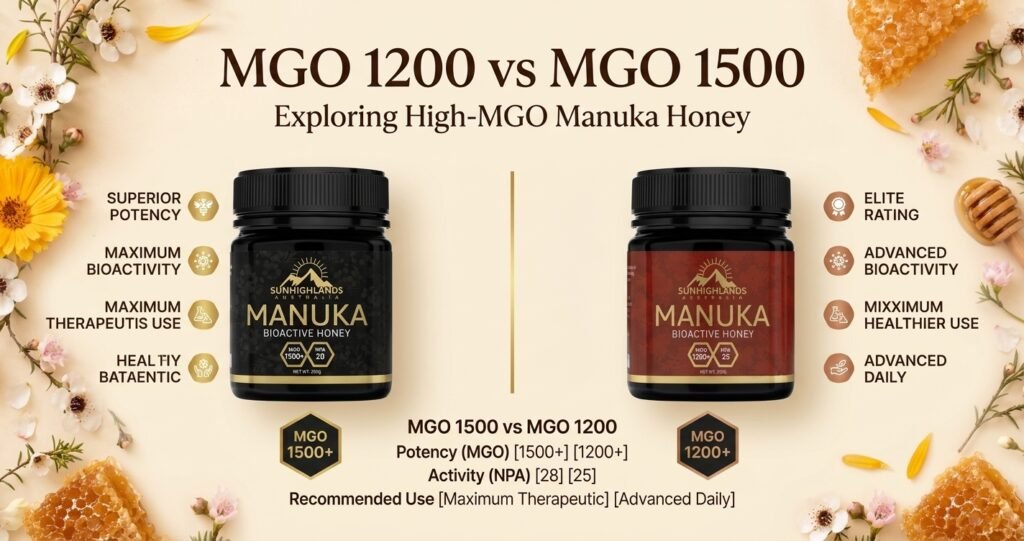
Manuka honey is available in different MGO ratings, and choosing between high-strength options can sometimes be confusing. MGO 1200+ and MGO 1500+ are both high-MGO Manuka honeys, but they have a clear numerical difference in their methylglyoxal concentration.
For Australian consumers interested in premium Manuka honey, understanding this difference can make it easier to compare products based on their MGO rating, origin, testing and intended use.
What Is MGO in Manuka Honey?
MGO stands for methylglyoxal, a naturally occurring compound associated with the distinctive characteristics of Manuka honey.
According to the Australian Manuka Honey Association (AMHA), MGO develops from dihydroxyacetone (DHA), which occurs naturally in the nectar of some Leptospermum plants. As Manuka honey matures, DHA can convert into MGO.
MGO can be measured through laboratory testing, giving consumers a specific numerical way to compare the concentration of this compound between different Manuka honey products.
What Does MGO 1200+ Mean?
MGO 1200+ indicates a very high MGO rating.
The number refers to the concentration of methylglyoxal in the honey, generally expressed in milligrams per kilogram (mg/kg). A 1200+ rating therefore represents a product with a high measured concentration of MGO.
A 250g MGO 1200+ product currently marketed in Australia lists 25 servings based on a 10g serving size.
What Does MGO 1500+ Mean?
MGO 1500+ represents an even higher MGO rating.
Compared with MGO 1200, the stated threshold is 300 mg/kg higher. Numerically, 1500 is 25% higher than 1200.
This difference should be understood strictly as a difference in MGO concentration. It should not be interpreted as meaning that MGO 1500+ provides a specific percentage more health benefit than MGO 1200+.
A current 250g MGO 1500+ product is also listed with a recommended serving size of 10g and 25 servings per package.
MGO 1200+ vs MGO 1500+: Key Differences
| Feature | MGO 1200+ | MGO 1500+ |
|---|---|---|
| MGO rating | 1200+ | 1500+ |
| Difference | — | 300 mg/kg higher |
| Numerical increase | — | 25% higher |
| Product format commonly available | 250g | 250g |
| Example serving size | 10g | 10g |
| MGO category | Very high | Higher still |
The primary difference is therefore straightforward: MGO 1500+ has a higher measured concentration of MGO than MGO 1200+.
Why Does Manuka Honey Have Different MGO Levels?
MGO levels begin with the natural chemistry of Leptospermum nectar.
The AMHA explains that Australian Manuka honey comes from nectar collected from Leptospermum species and that naturally occurring compounds such as DHA and MGO help establish the identity and characteristics of the honey.
Australia has a diverse range of Leptospermum species, and differences in floral source and regional conditions can contribute to variation in honey composition.
This natural variation is one reason different jars of Manuka honey can carry different MGO ratings.
Why Is MGO Testing Important?
When a product carries a specific MGO rating, laboratory testing is important for verifying that measurement.
The AMHA states that MGO can be directly measured using laboratory analysis and uses reliable scientific testing as part of its Australian Manuka honey quality approach.
The association’s Mark of Authenticity also requires qualifying Australian Manuka honey to be produced in Australia and independently tested against defined MGO and DHA criteria.
For consumers, this means it is useful to look for transparent information about MGO testing, authenticity and product origin when comparing high-MGO honeys.
Is MGO 1500+ Better Than MGO 1200+?
A higher MGO rating means a higher measured concentration of methylglyoxal, but that does not automatically make one product the right choice for every consumer.
Someone may choose MGO 1200+ because it offers a very high MGO rating and fits their preferred budget or routine. Another consumer may specifically want MGO 1500+ because they are looking for a higher MGO concentration.
Taste, price, origin, testing and intended use can all influence the choice.
The word “better” is therefore less useful than asking which MGO level matches your individual preferences.
What About Flavour and Texture?
MGO ratings do not determine the exact flavour or texture of Manuka honey.
Natural characteristics can vary depending on floral source, season and harvesting conditions. High-MGO Manuka honey is often described as rich and distinctive, but individual batches may differ.
Texture can also change over time. Natural crystallisation can make honey thicker or slightly grainy without necessarily indicating that the product has spoiled.
MGO Rating Is Not a Medical Dose
An important distinction when discussing high-MGO Manuka honey is that the rating describes concentration, not dosage.
MGO 1200+ and MGO 1500+ are not medical prescriptions. A higher rating does not mean that a person should consume a larger amount or that the product will produce a particular medical result.
Manuka honey should be viewed as a food unless it is specifically supplied as an approved medical product for a clinical use.
How Can You Use High-MGO Manuka Honey?
Both MGO 1200+ and MGO 1500+ can be used in everyday food and drink.
Try adding them to:
- Toast
- Porridge
- Greek yoghurt
- Fresh fruit
- Smoothies
- Warm drinks
- Homemade recipes
Because high-MGO Manuka honey is a premium product, many consumers prefer enjoying it directly or using it in foods where its distinctive flavour can be appreciated.
Remember that honey naturally contains sugars and carbohydrates, regardless of its MGO rating.
Which MGO Grade Should You Choose?
The choice between MGO 1200+ and MGO 1500+ mainly comes down to how much MGO you want in the product and what other factors matter to you.
Choose your product by considering:
MGO concentration: 1500+ has the higher stated concentration.
Australian origin: Check where the honey was produced and sourced.
Laboratory testing: Look for credible verification of the stated MGO level.
Authenticity: Consider recognised Australian Manuka honey quality or authenticity systems.
Serving size: Check the nutrition panel and recommended serving information.
Price and intended use: A higher rating may come at a higher cost, so consider what fits your routine.
Final Thoughts
MGO 1200+ and MGO 1500+ are both very high-MGO Manuka honey options, with MGO 1500+ representing a 300 mg/kg, or 25%, higher numerical threshold than MGO 1200.
The MGO rating comes from the naturally occurring chemistry of Leptospermum honey, while laboratory testing provides a way to measure and verify the concentration.
For Australian consumers, the most useful approach is to look beyond the number on the label. Consider MGO concentration, Australian origin, authenticity, independent testing, flavour, serving information and price together.
Whether you choose MGO 1200+ or MGO 1500+, understanding what the rating actually measures will help you make a more informed choice when exploring high-MGO Australian Manuka honey.

