
How an SEO Specialist in Dubai Can Help UAE Businesses Turn Google Searches Into Customers
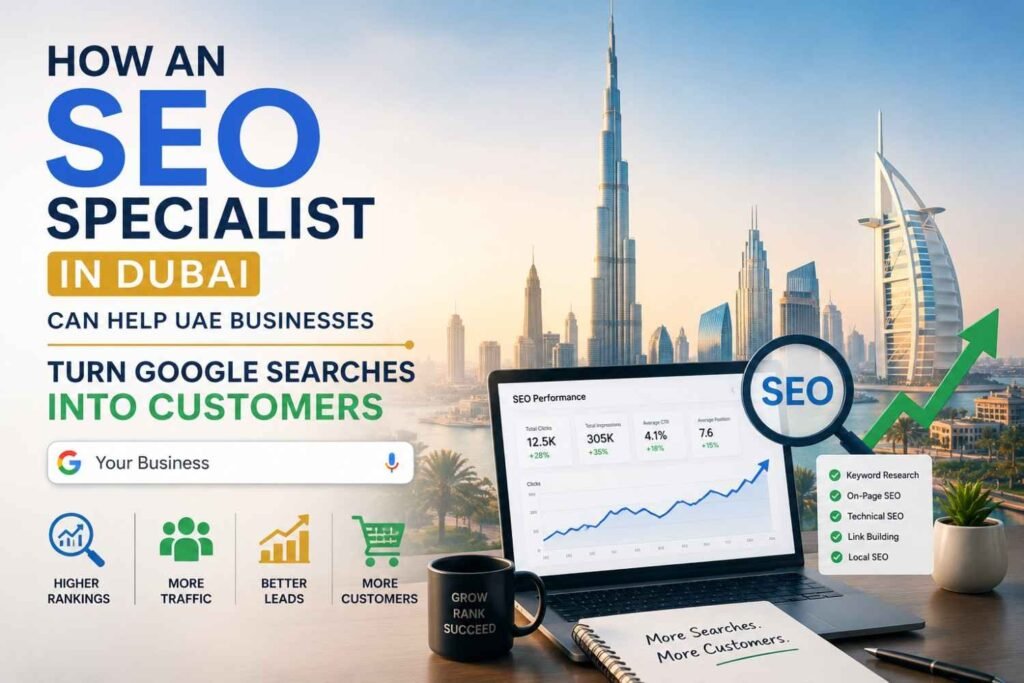
For businesses operating in Dubai and across the UAE, being visible when potential customers search on Google can have a direct impact on growth. People searching for accountants, real estate companies, clinics, repair services, professional firms, and B2B providers often compare several options before making contact. If a business does not appear prominently for relevant searches, it can miss valuable opportunities to competitors that have invested in search visibility.
This is where working with an experienced SEO specialist in Dubai can make a difference. Search engine optimization is no longer simply about adding keywords to webpages or trying to achieve higher rankings. A modern SEO strategy combines technical performance, useful content, website structure, authority building, local visibility, and conversion optimization.
For UAE businesses, the right approach also needs to account for location, competition, search behavior, and customer intent. A strategy designed for a business targeting Dubai may look very different from one targeting Abu Dhabi, Sharjah, or customers throughout the GCC.
Why SEO Matters for UAE Businesses
Google remains an important starting point for people researching products and services. A potential customer might search for a service near their location, compare providers, read reviews, or look for answers before contacting a company.
Organic search can help businesses reach these customers at different stages of the buying journey.
For example, someone looking for a repair company may initially search for information about a problem. Later, they might search for a specific service in Dubai and eventually compare local providers. A well-optimized website can potentially appear throughout these stages with relevant pages and useful information.
SEO can therefore support more than website traffic. When implemented properly, it can help businesses attract visitors who already have an interest in their products or services.
The objective should be to attract qualified search traffic rather than simply increasing the number of visitors.
Starting With a Comprehensive SEO Audit
Before making major changes to a website, it is important to understand what is already working and where problems exist.
An SEO audit provides a structured assessment of a website’s current search performance. It can identify technical problems, content weaknesses, opportunities for new keywords, internal linking issues, and other factors that may limit organic visibility.
A typical audit may examine:
Website crawlability and indexation
Page titles and meta descriptions
Heading structure
Internal links
Website speed
Mobile usability
Core Web Vitals
HTTPS implementation
Broken links
Duplicate or thin content
XML sitemap configuration
Robots.txt
Structured data
Existing backlinks
Keyword targeting
Competitor visibility
An audit can also uncover quick wins. Some improvements may require extensive technical work, while others could involve updating existing pages, improving metadata, strengthening internal links, or addressing indexing problems.
Starting with research allows an SEO specialist to create a strategy based on the website’s actual situation rather than relying on assumptions.
Building a Strong On-Page SEO Foundation
Once the website has been audited, on-page SEO becomes an important part of the optimization process.
On-page SEO involves improving individual webpages so search engines and users can better understand their purpose and relevance.
One of the first steps is keyword mapping. Instead of targeting the same keyword across multiple pages, relevant search terms can be assigned to appropriate pages based on search intent.
For example, a company offering several services may need separate pages for each major service. A location-based business may also benefit from dedicated pages for important service areas when those pages provide genuinely useful local information.
Optimizing Title Tags and Meta Descriptions
Title tags help communicate the topic of a webpage to search engines and users. A well-written title should clearly describe the page while naturally incorporating its primary topic.
Meta descriptions do not function as a simple ranking shortcut, but they can influence how a page is presented in search results and may encourage users to click.
Both elements should accurately represent the content rather than using exaggerated claims or keyword stuffing.
Improving Internal Linking
Internal links connect different pages within a website.
A thoughtful internal linking structure can help search engines discover pages and understand the relationship between different pieces of content. It can also guide visitors toward relevant services, supporting information, or conversion pages.
For example, an informative article about a particular business problem could link naturally to a related service page. This creates a better journey for users while also helping distribute internal authority throughout the site.
Creating Better Page Structure
Good SEO also requires good content organization.
Pages should use clear headings, logical sections, concise paragraphs, descriptive links, and useful information. The objective is to make content easy for both users and search engines to understand.
This becomes especially important for service businesses, where visitors often want answers quickly before deciding whether to make an inquiry.
Technical SEO: The Foundation Behind Visibility
A website can have excellent content and still experience search visibility problems if important technical issues are left unresolved.
Technical SEO focuses on the infrastructure and accessibility of a website.
An SEO specialist may review areas such as crawlability, indexation, website speed, mobile performance, redirects, canonical tags, structured data, HTTPS, and Core Web Vitals.
Website Speed and Core Web Vitals
Users expect websites to load efficiently, particularly on mobile devices. Slow pages can create a poor experience and may contribute to visitors leaving before taking action.
Core Web Vitals provide standardized measurements related to aspects of loading performance, responsiveness, and visual stability.
Improving these areas can involve optimizing images, reducing unnecessary scripts, improving server response times, using efficient caching, and addressing technical elements that slow down page delivery.
Crawlability and Indexation
Search engines need to discover and process webpages before they can potentially appear in search results.
Technical problems can prevent important pages from being crawled or indexed correctly. An SEO specialist can review sitemap files, robots directives, canonicalization, status codes, and other technical signals to identify potential barriers.
Fixing these issues helps ensure that search engines can access the pages that matter most to the business.
Schema Markup
Structured data, commonly referred to as schema markup, can provide search engines with additional information about webpage content.
Depending on the website and content type, structured data may be relevant for businesses, organizations, services, articles, products, events, and other entities.
It should be implemented accurately and in accordance with search engine guidelines.
Building Authority Through Off-Page SEO
SEO does not stop at the website itself.
Search engines also use signals from across the web to help understand the authority and relevance of websites. One component of this broader ecosystem is backlinks.
A backlink is a link from another website to your website. However, not all links have the same value.
A sustainable off-page strategy focuses on earning or acquiring relevant, credible links rather than building large quantities of low-quality links.
Useful approaches can include digital PR, industry publications, relevant directories, partnerships, editorial contributions, and other legitimate forms of outreach.
The emphasis should remain on quality and relevance.
Businesses should be cautious about strategies based entirely on large volumes of unrelated or low-quality backlinks, as these approaches may create more risk than long-term value.
Local SEO for Dubai and the UAE
For businesses serving customers in specific geographic areas, local SEO can be particularly important.
A customer searching for a service in Dubai may have very different intent from someone conducting a general informational search. Local search results can help people discover nearby businesses, compare providers, view reviews, and find contact information.
A local SEO strategy can include optimization of a Google Business Profile, location-relevant website content, consistent business information, reviews, local citations, and useful location pages.
Location pages should provide genuine value rather than simply replacing a city name throughout identical content.
For businesses serving multiple UAE locations, this distinction matters. A company targeting Dubai, Abu Dhabi, and Sharjah should consider whether each location deserves a dedicated page based on the services offered and the needs of customers in that market.
Turning Rankings Into Leads
Achieving rankings is only one part of the SEO process.
A website can receive significant organic traffic without generating many inquiries if the pages are difficult to navigate or lack clear calls to action.
This is why SEO can work alongside conversion rate optimization (CRO).
Conversion-focused improvements might include:
Clear contact forms
Visible phone numbers
Strong calls to action
Easy navigation
Service-specific landing pages
Trust signals
Customer reviews
Clear explanations of services
Frequently asked questions
Mobile-friendly contact options
The objective is to create a smooth path between a user’s search and the action the business wants them to take.
For a local service company, that action might be a phone call. For a B2B company, it could be a consultation request. For a professional services firm, it might be a form submission.
SEO Strategies Should Match Search Intent
One of the most important elements of modern SEO is understanding search intent.
People searching for information are not necessarily ready to purchase. Someone searching for “how to fix a leaking pipe” has a different intent from someone searching for “plumber in Dubai.”
The first query may indicate an informational need, while the second may indicate stronger commercial or transactional intent.
An effective content strategy can address different stages of the customer journey.
Informational content can answer common questions and establish topical relevance. Commercial pages can explain services and benefits. Location pages can address local searches. Strong conversion pages can make it easy for visitors to contact the company.
This approach helps create a website that serves users rather than simply targeting a collection of keywords.
Supporting Different Industries Across the UAE
SEO requirements can vary considerably between industries.
A real estate company may need to compete for property-related searches and location-specific queries. A clinic may require detailed service pages and locally relevant information. A repair company may benefit heavily from local search visibility.
Professional service businesses often need to establish trust and explain their expertise clearly. B2B companies may require more detailed educational content because purchasing decisions can involve multiple stakeholders.
For this reason, SEO should not be treated as a one-size-fits-all service.
The strategy should consider the business model, target audience, competitors, locations, services, and commercial objectives.
Measuring What Actually Matters
SEO reporting should go beyond ranking screenshots.
Rankings can provide useful information, but they do not always show whether SEO is contributing to business growth.
A meaningful monthly report can include metrics such as:
Organic traffic
Search visibility
Keyword performance
Landing-page performance
Qualified organic traffic
Leads and inquiries
Conversion activity
Technical improvements
Backlink development
Content published or updated
Priority actions for the next period
Looking at these metrics together provides a clearer picture of performance.
For example, a keyword may increase in rankings without generating meaningful business value. Conversely, a less prominent keyword could produce highly qualified visitors who become customers.
The most useful reporting connects SEO activity with measurable business outcomes.
Why a Dedicated SEO Specialist Can Help
Businesses often struggle with SEO because optimization involves many different areas at once.
Technical issues may require website development knowledge. Content optimization requires an understanding of search intent and audience needs. Local SEO involves location signals and business profiles. Off-page SEO requires outreach and authority development.
Having a dedicated SEO specialist can help coordinate these activities under one strategy.
Rather than making disconnected changes, the work can follow a structured process: audit the website, identify priorities, implement improvements, measure results, and refine the strategy based on data.
For businesses in Dubai and the wider UAE, this process can also be adapted to local competition and market conditions.
Dubai SEO With a Broader GCC Focus
Dubai is a highly competitive business market, but many UAE companies also want visibility beyond the city.
Businesses may target Abu Dhabi, Sharjah, other Emirates, or customers across the GCC.
Expanding SEO into additional markets requires more than adding location names to existing pages. Search behavior, competition, terminology, and customer expectations can differ between markets.
A scalable strategy should therefore identify the most valuable locations and search opportunities before creating new content or landing pages.
This approach can help businesses expand their organic presence while keeping the website organized and useful.
Choosing an SEO Partner for Long-Term Growth
SEO is an ongoing process rather than a one-time website task.
Search results change, competitors publish new content, websites evolve, and customer behavior shifts. A successful strategy needs regular monitoring and adjustments.
Businesses considering an SEO partner should look for a clear process, transparent reporting, realistic communication, and a focus on measurable outcomes.
The right approach should explain what is being changed, why it matters, how success will be measured, and what the next priorities are.
For companies operating in Dubai, Abu Dhabi, Sharjah, or across the GCC, an experienced SEO specialist in Dubai can provide the technical, content, local, and strategic expertise needed to build a stronger organic search presence.
Ultimately, SEO works best when a website is treated as more than an online brochure. With the right strategy, it can become a valuable channel for attracting people who are actively searching for the products and services a business provides.
From the initial SEO audit through on-page optimization, technical improvements, local SEO, authority building, and ongoing reporting, every activity should contribute to a clear objective: creating greater visibility and turning relevant search demand into meaningful business opportunities.
